The Medicare Spending Per Beneficiary (MSPB) Quality Measure is a claims-based measure. The MSPB looks at SNF resource utilization in comparison to the national average MSPB. This measure impacts the SNF QRP and Care Compare.
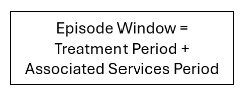
This quality measure uses an episode window. This is defined as the period for which Medicare FFS Part A and Part B services are counted toward the MSPB episode. The Treatment Period starts with a SNF admission and ends with a SNF discharge. The Associated Services Period starts with the SNF admission and ends 30 days after the end of the treatment period or30-days post-SNF discharge. The episodes can overlap with the Hospital MSPB measure and other PAC MSPB measures. This is purposeful to create accountability and align incentives across the care continuum.
The calculation for this measure is as follows:
- SNF episodes are selected for the measure period using final action Medicare FFS Part A and B claims data. Adjacent stays or Readmissions are collapsed into a single stay if the discharge date of the stay and the admission date of the subsequent stay are within 0 to 7 days. Readmissions after 8 or more days triggers a new episode.
- Episode window is defined. As stated above, this starts with a SNF admission and ends 30 days after SNF discharge.
- Price standardization is applied. A methodology is used to exclude geographic payment rate difference, such as hospital wage index and geographic practice cost index.
- Clinically unrelated services are excluded. Excludes services broadly includes planned hospital admissions, routine management of certain pre-existing chronic conditions (i.e., dialysis for ESRD, treatments for genetic conditions, cancer, etc.), and routine screenings and healthcare maintenance (i.e., colonoscopies and mammograms Immune-modulating medications)
- Services related to prior institutional care which occur on the first day of the episode are excluded. This includes ambulance transport, DME, prosthetics, orthotics, and supplies orders preceding admission to the SNF.
- Standardized episode spending is calculated. All standardized Medicare FFS Part A and B claims payments for services in the episode window are added together. The excluded services would not be included.
- Eligible SNF episodes are identified and included in the measure calculation. Episodes ending within the measure period are excluded if the following criteria are met: SNF claim outside the 50 states, D.C. Puerto Rico, and U.S. Territories, SNF claim for the episode in which the SNF provider treatment has a standard allowed amount of $0 or cannot be calculated, beneficiary is not enrolled in Medicare FFS for the entirety of a 90-day lookback period plus the episode window; OR the beneficiary is enrolled in Part C for any part of the lookback period plus episode window, beneficiary has a primary payer other than Medicare for any part of the 90-day lookback period plus episode window, SNF Provider treatment includes at least 1 related condition code indicating it is not a PPS bill and/or problematic or incomplete data is associated with the episode.
- Expected episode cost is calculated. An Ordinary Least Squares (OLS) regression methodology is used to estimate the impact of variables and standardized episode payment. In other words, covariates are used to regress from the standardized payment to the expected payment or cost. The covariates primarily use a 90-daylookback period and include age categories, Hierarchal Condition Codes, original reason for entitlement code of ESRD or disability, long-term care at start of episode, hospice during episode, prior acute ICU utilization days, prior acute length-of-stay categories, and/or 6 clinical case mix categories reflecting recent prior care within a 60-daylookback period.
- Predicated values are winsorized* to renormalize, maintaining a consistent average episode of payment. *Winsorized is a statistical method reducing the influence of extreme outliers in data by capping them at a certain percentile, instead of removing them.
- Outliers are excluded. The 1st and 99thpercentile are excluded from the calculation to remove episodes deviating most from the predicted value.
-

Finally, the SNF MSPB-PAC measure is calculated for each individual SNF for comparison to other SNFs.
Although this is a complicated claims-based measure for quality reporting, it is important to understand the basic construction of the calculation to allow for improvements in care provision and coding for financial success.
To learn more go to Skilled Nursing Facility (SNF) Quality Reporting Program (QRP) Measures and Technical Information | CMS.