The long-stay quality measure related to Outpatient Emergency Department (ED) Visits is a claims-based measure impacting Care Compare and Five Star. The measure is titled the Number of Outpatient Emergency Department Visits per 1,000 Long-Stay Residents Days.
The target period, or window, for this measure is the beginning of the 12-month target period or all days after a resident’s one-hundredth cumulative day in the nursing home, whichever is later, and goes until the day of discharge, death, or the end of the 12-month target period, whichever is earlier.
The numerator for this measure is the number of visits to the emergency department occurring while the beneficiary was a long-term nursing home resident. This does not include visits where the ED visit resulted in inpatient hospitalization or outpatient observation. Diagnosis(es) is not a factor. In addition, ED visits are not counted if the resident is enrolled in hospice.
The denominator for this measure is the sum of all long-stay days in the target period, divided by 1,000. It includes Medicare beneficiaries enrolled in Parts A and B. The denominator exclusions are:
- Resident was not a Medicare beneficiary or was enrolled in Medicare Advantage/managed care during any portion of the stay during the target period
- Resident did not have a comprehensive or quarterly assessment within 120 days prior to the resident becoming a long-stay resident
- Data is missing for any of the claims or MDS items used in the numerator, denominator, or risk-adjusters
- Resident was enrolled in hospice during the target period
- Resident was not in the nursing home for any reason during the episode. This would include admission to an inpatient facility or other institution or days the beneficiary resided in the community
The risk-adjusters for this measure include both claims-based and MDS-based covariates. The following are the claim-based covariates:
- Age
- Sex
- Race/Ethnicity
- Number of acute care hospitalizations in the 365 days before the day the resident became a long-stay resident or the beginning of the 12-month target period, whichever is later
- Outcome-Specific Comorbidity Index
The MDS-based covariates include the following:
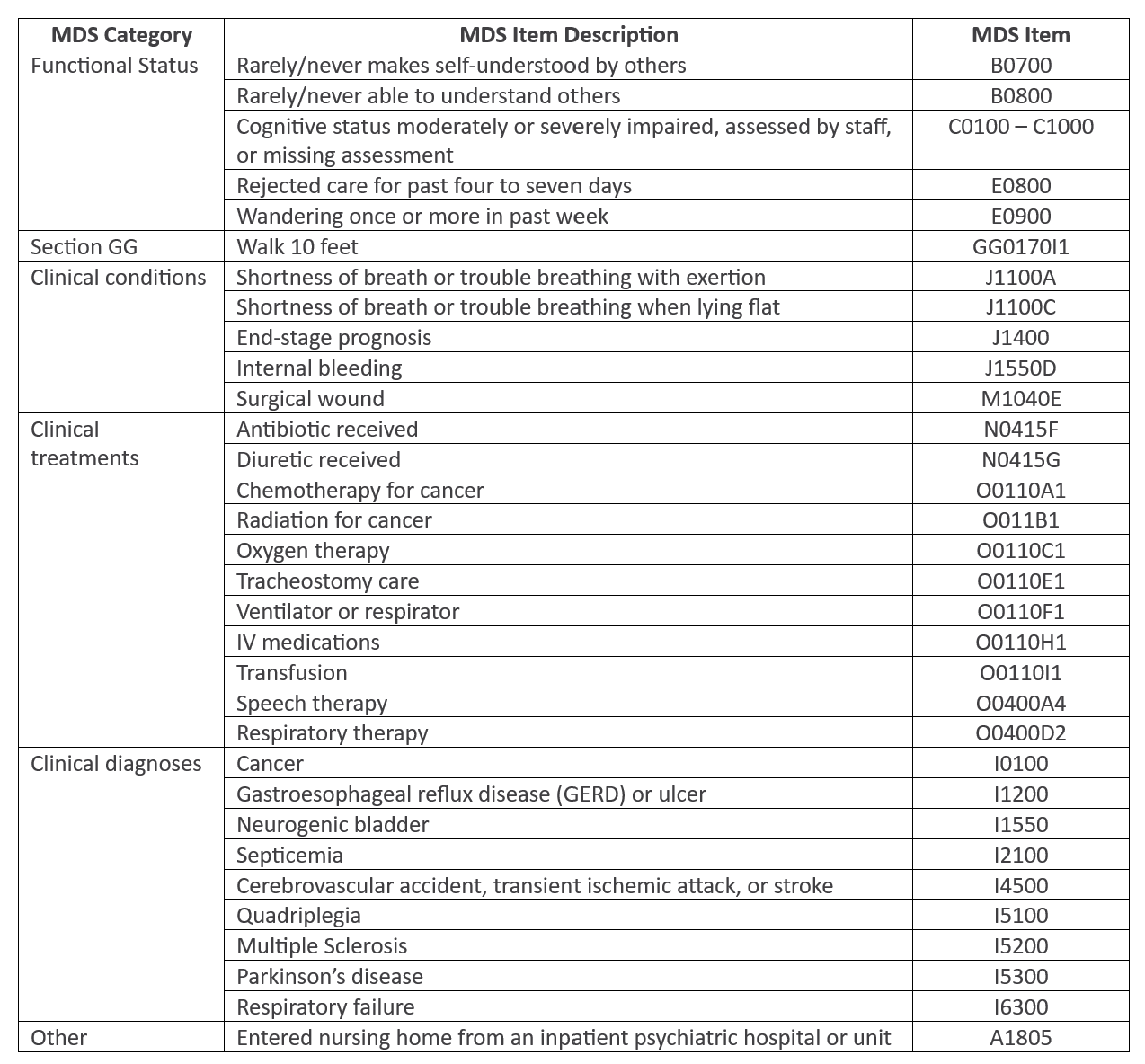


For this measure, a National Rate, an Observed Rate, and an Expected Rate are determined to arrive at a Risk Standardized Rate.
Teamwork among the Interdisciplinary Team is critical to limiting emergency room visits. A proactive approach through continual monitoring, screening, assessment, and communication regarding a resident’s condition can limit outpatient emergency room visits.
To learn more about this Quality Measure and more, go to CMS Quality Measures.